Lost Coast Chanties
Radio Bob Approved
- Joined
- May 26, 2022
- Messages
- 1,110
- Thread Author
- #1
Archduke
Franz Ferdinand Carl Ludwig
Joseph Maria of Austria
Franz Ferdinand Carl Ludwig
Joseph Maria of Austria
Early life
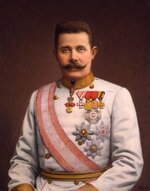
Franz Ferdinand was born in Graz, then part of the Austrian Empire, the eldest son of Archduke Karl Ludwig of Austria (the younger brother of Franz Joseph and Maximilian) and of his second wife, Princess Maria Annunziata of Bourbon-Two Sicilies. In 1875, when he was eleven years old, his cousin Francis V, Duke of Modena, died, naming Franz Ferdinand his heir on condition that he add the name "Este" to his own. This inheritance made Franz Ferdinand one of the wealthiest men in Austria.
Heir presumptive
In 1889, Franz Ferdinand's life changed dramatically. His cousin Crown Prince Rudolf committed suicide at his hunting lodge in Mayerling. This left Franz Ferdinand's father, Karl Ludwig, first in line to the throne. When Karl Ludwig died of typhoid fever in 1896, Franz Ferdinand became the heir presumptive to the Austro-Hungarian throne.
Despite this burden, he found time for travel and personal pursuits, such as his circumnavigation of the world between 1892 and 1893. After visiting India he spent time hunting kangaroos and emus in Australia in 1893, then travelled on to Nouméa, New Hebrides, Solomon Islands, New Guinea, Sarawak, Hong Kong and Japan. After sailing across the Pacific on the RMS Empress of China from Yokohama to Vancouver he crossed the United States, arriving at the World's Columbian Exposition 1893 on the Chicago, Burlington, and Quincy Railroad on a private Pullman car named Mascotte, and staying at the Lexington Hotel, before continuing through to New York and returning to Europe.
Franz Ferdinand had a fondness for trophy hunting that was excessive even by the standards of European nobility in his day. In his diaries he kept track of 272,511 game kills, 5,000 of which were deer. About 100,000 trophies were on exhibit at his Bohemian castle at Konopiště which he also stuffed with various antiquities, his other great passion.
Military career
Franz Ferdinand, like most males in the ruling Habsburg line, entered the Austro-Hungarian Army at a young age. He was frequently and rapidly promoted, given the rank of lieutenant at age fourteen, captain at twenty-two, colonel at twenty-seven, and major general at thirty-one. While never receiving formal staff training, he was considered eligible for command and at one point briefly led the primarily Hungarian 9th Hussar Regiment. In 1898 he was given a commission "at the special disposition of His Majesty" to make inquiries into all aspects of the military services and military agencies were commanded to share their papers with him.
He also held honorary ranks in the Austro-Hungarian Navy, and received the rank of admiral at the close of the Austro-Hungarian naval maneuvers in September 1902.
Franz Ferdinand exerted influence on the armed forces even when he did not hold a specific command through a military chancery that produced and received documents and papers on military affairs. This was headed by Alexander Brosch von Aarenau and eventually employed a staff of sixteen. His authority was reinforced in 1907 when he secured the retirement of the Emperor's confidant Friedrich von Beck-Rzikowsky as Chief of the General Staff. Beck's successor, Franz Conrad von Hötzendorf, was personally selected by Franz Ferdinand.
Franz in 1913, as heir-presumptive to the elderly emperor, had been appointed inspector general of all the armed forces of Austria-Hungary (Generalinspektor der gesamten bewaffneten Macht), a position superior to that previously held by Archduke Albrecht and including presumed command in wartime.
Marriage and family
In 1894, Franz Ferdinand met Countess Sophie Chotek, a lady-in-waiting to Archduchess Isabella, wife of Archduke Friedrich, Duke of Teschen. Franz began to visit Archduke Friedrich's villa in Pressburg (now Bratislava), and in turn Sophie wrote to Franz Ferdinand during his convalescence from tuberculosis on the island of Lošinj in the Adriatic. They kept their relationship a secret, until it was discovered by Isabella.
To be eligible to marry a member of the imperial House of Habsburg, one had to be a member of one of the reigning or formerly reigning dynasties of Europe. The Choteks were not one of these families. Deeply in love, Franz Ferdinand refused to consider marrying anyone else. Finally, in 1899, Emperor Franz Joseph agreed to permit Franz Ferdinand to marry Sophie, provided that the marriage would be morganatic and that their descendants would not have succession rights to the throne. Sophie would not share her husband's rank, title, precedence, or privileges, nor would she normally appear in public beside him. She would not be allowed to ride in the royal carriage or sit in the royal box in theaters.
The wedding took place on 1 July 1900, at Reichstadt (now Zákupy) in Bohemia; Franz Joseph did not attend the ceremony, nor did Franz Ferdinand's brothers or any other archduke. The only members of the imperial family present were Franz Ferdinand's stepmother, Princess Maria Theresa of Braganza, and her two daughters. Upon the marriage, Sophie was given the title "Princess of Hohenberg" (Fürstin von Hohenberg) with the style "Her Serene Highness" (Ihre Durchlaucht). In 1909, she was given the more senior title "Duchess of Hohenberg" (Herzogin von Hohenberg) with the style "Her Highness" (Ihre Hoheit). This raised her status considerably, but she was still required to yield precedence at court to all the archduchesses. Whenever a function required the couple to assemble with the other members of the imperial family, Sophie had to stand far down the line, separated from her husband.
Franz Ferdinand's children were:
Princess Sophie of Hohenberg (1901–1990), married Count Friedrich von Nostitz-Rieneck (1891–1973)
Maximilian, Duke of Hohenberg (1902–1962), married Countess Elisabeth von Waldburg zu Wolfegg und Waldsee (1904–1993)
Prince Ernst of Hohenberg (1904–1954), married Marie-Therese Wood (1910–1985)
Stillborn son (1908), buried in Artstetten Castle, near his parents[29][30]
Franz Ferdinand and Sophie visited England in the autumn of 1913, spending a week with George V and Queen Mary at Windsor Castle before going to stay for another week with the Duke of Portland at Welbeck Abbey, Nottinghamshire, where they arrived on 22 November. He attended a service at the local Catholic church in Worksop. Franz Ferdinand and the Duke of Portland went game shooting on the Welbeck estate when, according to Portland's memoirs, Men, Women and Things:
One of the loaders fell down. This caused both barrels of the gun he was carrying to be discharged, the shot passing within a few feet of the archduke and myself. I have often wondered whether the Great War might not have been averted, or at least postponed, had the archduke met his death there and not in Sarajevo the following year.
Assassination
On Sunday, 28 June 1914, at about 10:45 am, Franz Ferdinand and his wife were assassinated in Sarajevo, the capital of the Austro-Hungarian province of Bosnia and Herzegovina. The perpetrator was 19-year-old Gavrilo Princip, a member of Young Bosnia and one of a group of assassins organized and armed by the Black Hand.
Earlier in the day, the couple had been attacked by Nedeljko Čabrinović, also a Young Bosnia conspirator, who had thrown a grenade at their car. However, the bomb detonated behind them, injuring the occupants in the following car. On arriving at the Governor's residence, Franz asked "So you welcome your guests with bombs!"
After a short rest at the Governor's residence, the royal couple insisted on seeing all those who had been injured by the bomb at the local hospital. However, no one told the drivers that the itinerary had been changed. When the error was discovered, the drivers had to turn around. As the cars backed down the street and onto a side street, the line of cars stalled. At this time, Princip was sitting at a cafe across the street. He instantly seized his opportunity and walked across the street and shot the royal couple. He first shot Sophie in the abdomen and then shot Franz Ferdinand in the neck. Franz leaned over his crying wife. He was still alive when witnesses arrived to render aid. His dying words to Sophie were, "Don't die darling, live for our children." Princip's weapon was the pocket-sized FN Model 1910 pistol chambered for the .380 ACP cartridge provided him by Serbian Army Military Intelligence Lieutenant-Colonel and Black Hand leader Dragutin Dimitrijević. Franz Ferdinand's aides attempted to undo his coat but realized they needed scissors to cut it open: the outer lapel had been sewn to the inner front of the jacket for a smoother fit to improve his appearance to the public. Whether or not as a result of this obstacle, his wound could not be attended to in time to save him, and he died within minutes. Sophie also died en route to the hospital.
A detailed account of the shooting can be found in Sarajevo by Joachim Remak:
One bullet pierced Franz Ferdinand's neck while the other pierced Sophie's abdomen. ... As the car was reversing (to go back to the Governor's residence because the entourage thought the Imperial couple were unhurt) a thin streak of blood shot from the Archduke's mouth onto Count Harrach's right cheek (he was standing on the car's running board). Harrach drew out a handkerchief to still the gushing blood. The Duchess, seeing this, called: "For Heaven's sake! What happened to you?" and sank from her seat, her face falling between her husband's knees.
Harrach and Potoriek ... thought she had fainted ... only her husband seemed to have an instinct for what was happening. Turning to his wife despite the bullet in his neck, Franz Ferdinand pleaded: "Sopherl! Sopherl! Sterbe nicht! Bleibe am Leben für unsere Kinder! – Sophie dear! Don't die! Stay alive for our children!" Having said this, he seemed to sag down himself. His plumed hat ... fell off; many of its green feathers were found all over the car floor. Count Harrach seized the Archduke by the uniform collar to hold him up. He asked "Leiden Eure Kaiserliche Hoheit sehr? – Is Your Imperial Highness suffering very badly?" "Es ist nichts. – It is nothing." said the Archduke in a weak but audible voice. He seemed to be losing consciousness during his last few minutes, but, his voice growing steadily weaker, he repeated the phrase perhaps six or seven times more.
A rattle began to issue from his throat, which subsided as the car drew in front of the Konak bersibin (Town Hall). Despite several doctors' efforts, the Archduke died shortly after being carried into the building while his beloved wife was almost certainly dead from internal bleeding before the motorcade reached the Konak.
The assassinations, along with the arms race, nationalism, imperialism, militarism of Imperial Germany and the alliance system all contributed to the origins of World War I, which began a month after Franz Ferdinand's death, with Austria-Hungary's declaration of war against Serbia. The assassination of Franz Ferdinand is considered the most immediate cause of World War I.
After his death, Archduke Karl became the heir presumptive of Austria-Hungary. Franz Ferdinand was buried with his wife Sophie in Artstetten Castle, Austria.
Franz Ferdinand was born in Graz, then part of the Austrian Empire, the eldest son of Archduke Karl Ludwig of Austria (the younger brother of Franz Joseph and Maximilian) and of his second wife, Princess Maria Annunziata of Bourbon-Two Sicilies. In 1875, when he was eleven years old, his cousin Francis V, Duke of Modena, died, naming Franz Ferdinand his heir on condition that he add the name "Este" to his own. This inheritance made Franz Ferdinand one of the wealthiest men in Austria.
Heir presumptive
In 1889, Franz Ferdinand's life changed dramatically. His cousin Crown Prince Rudolf committed suicide at his hunting lodge in Mayerling. This left Franz Ferdinand's father, Karl Ludwig, first in line to the throne. When Karl Ludwig died of typhoid fever in 1896, Franz Ferdinand became the heir presumptive to the Austro-Hungarian throne.
Despite this burden, he found time for travel and personal pursuits, such as his circumnavigation of the world between 1892 and 1893. After visiting India he spent time hunting kangaroos and emus in Australia in 1893, then travelled on to Nouméa, New Hebrides, Solomon Islands, New Guinea, Sarawak, Hong Kong and Japan. After sailing across the Pacific on the RMS Empress of China from Yokohama to Vancouver he crossed the United States, arriving at the World's Columbian Exposition 1893 on the Chicago, Burlington, and Quincy Railroad on a private Pullman car named Mascotte, and staying at the Lexington Hotel, before continuing through to New York and returning to Europe.
Franz Ferdinand had a fondness for trophy hunting that was excessive even by the standards of European nobility in his day. In his diaries he kept track of 272,511 game kills, 5,000 of which were deer. About 100,000 trophies were on exhibit at his Bohemian castle at Konopiště which he also stuffed with various antiquities, his other great passion.
Military career
Franz Ferdinand, like most males in the ruling Habsburg line, entered the Austro-Hungarian Army at a young age. He was frequently and rapidly promoted, given the rank of lieutenant at age fourteen, captain at twenty-two, colonel at twenty-seven, and major general at thirty-one. While never receiving formal staff training, he was considered eligible for command and at one point briefly led the primarily Hungarian 9th Hussar Regiment. In 1898 he was given a commission "at the special disposition of His Majesty" to make inquiries into all aspects of the military services and military agencies were commanded to share their papers with him.
He also held honorary ranks in the Austro-Hungarian Navy, and received the rank of admiral at the close of the Austro-Hungarian naval maneuvers in September 1902.
Franz Ferdinand exerted influence on the armed forces even when he did not hold a specific command through a military chancery that produced and received documents and papers on military affairs. This was headed by Alexander Brosch von Aarenau and eventually employed a staff of sixteen. His authority was reinforced in 1907 when he secured the retirement of the Emperor's confidant Friedrich von Beck-Rzikowsky as Chief of the General Staff. Beck's successor, Franz Conrad von Hötzendorf, was personally selected by Franz Ferdinand.
Franz in 1913, as heir-presumptive to the elderly emperor, had been appointed inspector general of all the armed forces of Austria-Hungary (Generalinspektor der gesamten bewaffneten Macht), a position superior to that previously held by Archduke Albrecht and including presumed command in wartime.
Marriage and family
In 1894, Franz Ferdinand met Countess Sophie Chotek, a lady-in-waiting to Archduchess Isabella, wife of Archduke Friedrich, Duke of Teschen. Franz began to visit Archduke Friedrich's villa in Pressburg (now Bratislava), and in turn Sophie wrote to Franz Ferdinand during his convalescence from tuberculosis on the island of Lošinj in the Adriatic. They kept their relationship a secret, until it was discovered by Isabella.
To be eligible to marry a member of the imperial House of Habsburg, one had to be a member of one of the reigning or formerly reigning dynasties of Europe. The Choteks were not one of these families. Deeply in love, Franz Ferdinand refused to consider marrying anyone else. Finally, in 1899, Emperor Franz Joseph agreed to permit Franz Ferdinand to marry Sophie, provided that the marriage would be morganatic and that their descendants would not have succession rights to the throne. Sophie would not share her husband's rank, title, precedence, or privileges, nor would she normally appear in public beside him. She would not be allowed to ride in the royal carriage or sit in the royal box in theaters.
The wedding took place on 1 July 1900, at Reichstadt (now Zákupy) in Bohemia; Franz Joseph did not attend the ceremony, nor did Franz Ferdinand's brothers or any other archduke. The only members of the imperial family present were Franz Ferdinand's stepmother, Princess Maria Theresa of Braganza, and her two daughters. Upon the marriage, Sophie was given the title "Princess of Hohenberg" (Fürstin von Hohenberg) with the style "Her Serene Highness" (Ihre Durchlaucht). In 1909, she was given the more senior title "Duchess of Hohenberg" (Herzogin von Hohenberg) with the style "Her Highness" (Ihre Hoheit). This raised her status considerably, but she was still required to yield precedence at court to all the archduchesses. Whenever a function required the couple to assemble with the other members of the imperial family, Sophie had to stand far down the line, separated from her husband.
Franz Ferdinand's children were:
Princess Sophie of Hohenberg (1901–1990), married Count Friedrich von Nostitz-Rieneck (1891–1973)
Maximilian, Duke of Hohenberg (1902–1962), married Countess Elisabeth von Waldburg zu Wolfegg und Waldsee (1904–1993)
Prince Ernst of Hohenberg (1904–1954), married Marie-Therese Wood (1910–1985)
Stillborn son (1908), buried in Artstetten Castle, near his parents[29][30]
Franz Ferdinand and Sophie visited England in the autumn of 1913, spending a week with George V and Queen Mary at Windsor Castle before going to stay for another week with the Duke of Portland at Welbeck Abbey, Nottinghamshire, where they arrived on 22 November. He attended a service at the local Catholic church in Worksop. Franz Ferdinand and the Duke of Portland went game shooting on the Welbeck estate when, according to Portland's memoirs, Men, Women and Things:
One of the loaders fell down. This caused both barrels of the gun he was carrying to be discharged, the shot passing within a few feet of the archduke and myself. I have often wondered whether the Great War might not have been averted, or at least postponed, had the archduke met his death there and not in Sarajevo the following year.
Assassination
On Sunday, 28 June 1914, at about 10:45 am, Franz Ferdinand and his wife were assassinated in Sarajevo, the capital of the Austro-Hungarian province of Bosnia and Herzegovina. The perpetrator was 19-year-old Gavrilo Princip, a member of Young Bosnia and one of a group of assassins organized and armed by the Black Hand.
Earlier in the day, the couple had been attacked by Nedeljko Čabrinović, also a Young Bosnia conspirator, who had thrown a grenade at their car. However, the bomb detonated behind them, injuring the occupants in the following car. On arriving at the Governor's residence, Franz asked "So you welcome your guests with bombs!"
After a short rest at the Governor's residence, the royal couple insisted on seeing all those who had been injured by the bomb at the local hospital. However, no one told the drivers that the itinerary had been changed. When the error was discovered, the drivers had to turn around. As the cars backed down the street and onto a side street, the line of cars stalled. At this time, Princip was sitting at a cafe across the street. He instantly seized his opportunity and walked across the street and shot the royal couple. He first shot Sophie in the abdomen and then shot Franz Ferdinand in the neck. Franz leaned over his crying wife. He was still alive when witnesses arrived to render aid. His dying words to Sophie were, "Don't die darling, live for our children." Princip's weapon was the pocket-sized FN Model 1910 pistol chambered for the .380 ACP cartridge provided him by Serbian Army Military Intelligence Lieutenant-Colonel and Black Hand leader Dragutin Dimitrijević. Franz Ferdinand's aides attempted to undo his coat but realized they needed scissors to cut it open: the outer lapel had been sewn to the inner front of the jacket for a smoother fit to improve his appearance to the public. Whether or not as a result of this obstacle, his wound could not be attended to in time to save him, and he died within minutes. Sophie also died en route to the hospital.
A detailed account of the shooting can be found in Sarajevo by Joachim Remak:
One bullet pierced Franz Ferdinand's neck while the other pierced Sophie's abdomen. ... As the car was reversing (to go back to the Governor's residence because the entourage thought the Imperial couple were unhurt) a thin streak of blood shot from the Archduke's mouth onto Count Harrach's right cheek (he was standing on the car's running board). Harrach drew out a handkerchief to still the gushing blood. The Duchess, seeing this, called: "For Heaven's sake! What happened to you?" and sank from her seat, her face falling between her husband's knees.
Harrach and Potoriek ... thought she had fainted ... only her husband seemed to have an instinct for what was happening. Turning to his wife despite the bullet in his neck, Franz Ferdinand pleaded: "Sopherl! Sopherl! Sterbe nicht! Bleibe am Leben für unsere Kinder! – Sophie dear! Don't die! Stay alive for our children!" Having said this, he seemed to sag down himself. His plumed hat ... fell off; many of its green feathers were found all over the car floor. Count Harrach seized the Archduke by the uniform collar to hold him up. He asked "Leiden Eure Kaiserliche Hoheit sehr? – Is Your Imperial Highness suffering very badly?" "Es ist nichts. – It is nothing." said the Archduke in a weak but audible voice. He seemed to be losing consciousness during his last few minutes, but, his voice growing steadily weaker, he repeated the phrase perhaps six or seven times more.
A rattle began to issue from his throat, which subsided as the car drew in front of the Konak bersibin (Town Hall). Despite several doctors' efforts, the Archduke died shortly after being carried into the building while his beloved wife was almost certainly dead from internal bleeding before the motorcade reached the Konak.
The assassinations, along with the arms race, nationalism, imperialism, militarism of Imperial Germany and the alliance system all contributed to the origins of World War I, which began a month after Franz Ferdinand's death, with Austria-Hungary's declaration of war against Serbia. The assassination of Franz Ferdinand is considered the most immediate cause of World War I.
After his death, Archduke Karl became the heir presumptive of Austria-Hungary. Franz Ferdinand was buried with his wife Sophie in Artstetten Castle, Austria.
Reserved