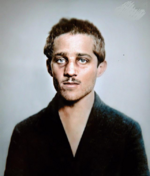
" I am a Yugoslav nationalist, aiming for the unification of all Yugoslavs, and I do not care what form of state, but it must be free from Austria... The plan was to unite all South Slavs. It was understood that Serbia as the free part of the South Slavs had the moral duty to help in the unification, to be to the South Slavs as the Piedmont was to Italy... In my opinion every Serb, Croat and Slovene should be an enemy of Austria."
- Gavrilo Princip, to the court
Early Life
Gavrilo Princip was born on 25 July 1894, in the remote hamlet of Obljaj, near Bosansko Grahovo, in western Bosnia. Bosnia was administered by Austria-Hungary, while still formally a province of the Ottoman Empire. He was the second of his parents' nine children, six of whom died in infancy. Princip's mother Marija wanted to name him after her late brother, Špiro, but he was named Gavrilo at the insistence of a local Eastern Orthodox priest, who claimed naming the sickly infant after the Archangel Gabriel would help him survive.
Joining Young Bosnia
Following the annexation of the region by the Austro-Hungarian empire in 1908, Bosnia, like the other southern Slavic states under imperial rule, yearned for independence. As a result, various student groups emerged interested in movements such as romantic nationalism, nihilism, or anti imperialism. While at school and through his roommate Danilo Ilić, Princip was also exposed to socialist, anarchist, and communist writing. Princip started to associate with like-minded young nationalist revolutionaries and came to admire Bogdan Žerajić, a Bosnian Serb who had attempted to assassinate the Austro-Hungarian Governor of Bosnia and Herzegovina, before taking his own life. Žerajić, who was from Herzegovina like Princip, came to epitomize, in the eyes of many, the ideal of self sacrifice. On the anniversary of his death, Serb youths from Sarajevo started to visit his grave to lay flowers. According to Luigi Albertini, this is where, after spending nights reflecting at the grave, that Princip resolved to participate in his own attack. In 1911, Princip graduated from the fourth grade and joined Young Bosnia (Serbian: Mlada Bosna), a society with members from all three major Bosnian ethnic groups, that sought the liberation of Bosnia from Austro-Hungarian rule and the unification of all Southern Slavs in a common nation. Some believed that the newly independent Kingdom of Serbia, as the free part of the south Slavs, was obligated to help unify the southern Slavic peoples. Because the local authorities had forbidden students to form organisations and clubs, Princip and other members of Young Bosnia met in secret. During their meetings, they discussed literature, ethics and politics.
Princip proved to be the best marksman. The three-man assassination team left Belgrade on 28 May 1914, taking a river boat that took them to Šabac, they then split up crossing separately the border into Bosnia. Each of them was carrying two bombs tied around their waist as well as pistols, ammunition and a bottle of cyanide in their pockets. Before leaving Serbia, Princip wrote to his former roommate in Sarajevo Danilo Ilić, to notify him of his assassination plan and to ask him to recruit more people. Ilić recruited Muhamed Mehmedbašić, a Bosnian Muslim carpenter, Cvetko Popović, and Vaso Čubrilović, both Bosnian Serb students aged eighteen and seventeen.
Assassination of Archduke Franz Ferdinand
Archduke Franz Ferdinand of Austria and his wife, Duchess Sophie Chotek, arrived in Sarajevo by train shortly before 10 a.m. on 28 June 1914. Their car was the third in a six-car motorcade heading towards Sarajevo Town Hall.
Princip and five other conspirators were positioned along the route, spaced out along the Appel Quay, each instructed to assassinate the Archduke when the royal car reached their position. The first, Muhamed Mehmedbašić, stood near the Austro-Hungarian Bank but lost his nerve and allowed the car to pass without acting. At 10:15 am, as the motorcade passed the central police station, 19-year-old student Nedeljko Čabrinović hurled a grenade at the Archduke's car. The driver accelerated upon seeing the grenade, which had a 10-second delay, and the bomb exploded under the fourth car, seriously wounding two occupants. Following this failed attempt, the motorcade sped away, and the remaining conspirators, including Princip, were unable to act due to the speed of the vehicles.
After delivering his scheduled speech at the Town Hall, the Archduke decided to visit the victims of Čabrinović's grenade attack at the Sarajevo Hospital. To avoid the city centre, General Oskar Potiorek directed the royal car to travel straight along the Appel Quay to the hospital. However, Potiorek failed to inform the driver, Leopold Lojka, a Czech, about this change. On the way to the hospital, Lojka, following the original plan, turned onto a side street where Princip happened to be standing in front of a delicatessen. After Potiorek shouted at him to stop, Lojka halted the car and began reversing. As he did so, the engine stalled, and the gears locked. Princip stepped forward, drew an FN Model 1910 semi-automatic pistol, and fired twice at close range into the car. The first bullet struck the Archduke in the neck, while the second hit the Duchess in the abdomen. Both died shortly afterward.
Arrest and imprisonment
Before Princip could fire for a third time, the pistol was wrested from his hand and he was pushed to the ground. He managed to swallow a capsule of cyanide, which failed to kill him. The trial opened on 12 October and lasted until 23 October 1914. Princip and twenty-four people were indicted. All six assassins, except Mehmedbašić, were under twenty at the time of the assassination. While the group was dominated by Bosnian Serbs, four of the indicted were Bosnian Croats and all of them were Austro-Hungarian citizens, none being from Serbia. The state's attorney charged twenty-two of the accused with high treason and murder and three with complicity in the murder. Princip stated that he regretted the killing of the Duchess and meant to kill Potiorek, but was nonetheless proud of what he had done. The Austrian police investigators were eager to emphasise the exclusively Serbian nature of the assassination plot for political reasons, but during his trial Princip insisted that, even though he was an ethnic Serb, his commitment was to freeing all south Slavs. All the chief conspirators mentioned the revolutionary destruction of Austria-Hungary and the liberation of the South Slavs as the motivation behind their act.
Princip was nineteen years old at the time and too young to be executed, as he was twenty-seven days shy of the twenty-year minimum age limit required by Habsburg law. On Thursday 28 October 1914 the court found Princip guilty of murder and high treason, he received the maximum sentence of twenty years in prison, he was to serve out his sentence in a military prison within the Habsburg fortress of Theresienstadt in northern Bohemia.
Princip died on 28 April 1918, nearly four years after the assassination. At the time of his death, weakened by tuberculosis and prolonged malnutrition, he weighed only about 40 kilograms
This site uses cookies to help personalise content, tailor your experience and to keep you logged in if you register.
By continuing to use this site, you are consenting to our use of cookies.