Welcome!

By registering with us, you'll be able to discuss, share and private message with other members of our community.

SignUp Now!

Question about PKs

  • Thread starter Thread starter AdamCF
  • Start date Start date
A

AdamCF

Guest
Let’s say you’re a rebel. There’s an imposter in your group, and you spot someone acting sus! You know someone’s been telling the Combine about your plans, and you think you know who. So you watch them, and you become certain it’s them. A massive list of reasons to believe they’re the one responsible. So you and your team gather together and kill him.

But... he didn’t do anything. While you had enough reasons to be sure he’d been working with the combine, he wasn’t.

Would this scenario be a valid PK? Does “I didn’t do it” overrule any IC reasoning or investigation?
 
Let’s say you’re a rebel. There’s an imposter in your group, and you spot someone acting sus! You know someone’s been telling the Combine about your plans, and you think you know who. So you watch them, and you become certain it’s them. A massive list of reasons to believe they’re the one responsible. So you and your team gather together and kill him.

But... he didn’t do anything. While you had enough reasons to be sure he’d been working with the combine, he wasn’t.

Would this scenario be a valid PK? Does “I didn’t do it” overrule any IC reasoning or investigation?
In the last community I was in someone could be PKed for developmental reasoning, meaning their death was so important or a major event in the story of other's that they couldn't just respawn like nothing happened. I'd say something like that could qualify. Of course, I don't know quite how PKs are done here but I don't see the logic in someone coming back after you've plotted to kill them with others, even if you were wrong in the end.
 
I’m on the “if you can justify it with IC reasons, it’s valid”. So if you find evidence someone commits a crime and have suspicion beyond reasonable doubt, a CP can PK and “But I didn’t actually do it” isn’t enough for an un-PK. I only made this post because terranova seemed to almost always un-PK if the character didnt actually do it, meaning any IC investigation or reasoning behind your suspicion is just thrown away.
 
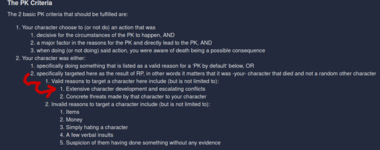
As for "Invalid Reason #5: Suspicion with no evidence." I'd say that following someone and observing them is evidence to your character, and eveidence to others if they're with you. Therefore the planning and killing of a character for observed (by your/other characters) evidence is valid. As for OOC evidence if this comes up for staff or appeals, if there are logs of you hiding/following/observing someone, show that or have staff check logs, and possibly take screenshots too for more "hard" OOC evidence
PK.png
 
As for "Invalid Reason #5: Suspicion with no evidence." I'd say that following someone and observing them is evidence to your character, and eveidence to others if they're with you. Therefore the planning and killing of a character for observed (by your/other characters) evidence is valid. As for OOC evidence if this comes up for staff or appeals, if there are logs of you hiding/following/observing someone, show that or have staff check logs, and possibly take screenshots too for more "hard" OOC evidence
View attachment 2617
So, 'Extensive character development and escalating conflicts' would include any sort of investigation into a possible betrayal?
 
So, 'Extensive character development and escalating conflicts' would include any sort of investigation into a possible betrayal?
As the one who made the rule: yes. That rule exists to cover the situations where it wasn't a singular clear thing that is cause for the PK, but the reason is (a lot of) (small) things being added together. This can be over the course of a few minutes (e.g. you insult someone, fist fight start, ends with someone being shot) or stretching over months.

Just be aware of the requirements under the first criteria, the character you are killing should have had at least one chance to avert this PK (and preferably more). Example here would be that you offer him to explain himself but he refuses, or you publicly accuse him and he gets hostile rather than demonstrating he isn't a snitch. I don't want to create a loophole where if you do enough 'investigation RP' behind someone's back you can get a PK out of it.

Or just take it like this: 'extensive character development and escalating conflicts' should involve both sides, not just one side while the other has no clue of conflict escalating or getting any RP out of it.


For suspicion without evidence: you got three guys, one of which you know killed someone. You shoot all three and request PK's. Two get NLR'ed for 'wrong place, wrong time' and one gets PK'ed. The rule against 'no evidence' killings prevents that PK roulette. It also stops PK's based purely on hearsay. Being direct witness to anything that can be a good PK reason obviously means this no longer applies.

But for your example, the main matter is in how you escalate the conflict, and if you do that right the PK will come from that and not your suspicion. Even if you somehow found 'valid evidence' that the guy did something, while in fact he did not do it, you would still have no way to PK him out of nowhere.

 
Last edited:
As the one who made the rule: yes. That rule exists to cover the situations where it wasn't a singular clear thing that is cause for the PK, but the reason is (a lot of) (small) things being added together. This can be over the course of a few minutes (e.g. you insult someone, fist fight start, ends with someone being shot) or stretching over months.

Just be aware of the requirements under the first criteria, the character you are killing should have had at least one chance to avert this PK (and preferably more). Example here would be that you offer him to explain himself but he refuses, or you publicly accuse him and he gets hostile rather than demonstrating he isn't a snitch. I don't want to create a loophole where if you do enough 'investigation RP' behind someone's back you can get a PK out of it.

Or just take it like this: 'extensive character development and escalating conflicts' should involve both sides, not just one side while the other has no clue of conflict escalating or getting any RP out of it.


For suspicion without evidence: you got three guys, one of which you know killed someone. You shoot all three and request PK's. Two get NLR'ed for 'wrong place, wrong time' and one gets PK'ed. The rule against 'no evidence' killings prevents that PK roulette. It also stops PK's based purely on hearsay. Being direct witness to anything that can be a good PK reason obviously means this no longer applies.

But for your example, the main matter is in how you escalate the conflict, and if you do that right the PK will come from that and not your suspicion. Even if you somehow found 'valid evidence' that the guy did something, while in fact he did not do it, you would still have no way to PK him out of nowhere.
Alright, that clears things up quite a bit. Thanks
 
Back
Top